Borland International, Inc.
Paradox
In 1985, a company called Ansa Software based in Belmont, CA., released a new high-speed relational database management system (RDBMS) for DOS 2.0 called Paradox. This was innovative, entering a market dominated by dBase II and III. From its first version, it permitted the importing of dBase data into Paradox, and data could be queried by providing examples of what the user needed.
In September 1987, Borland purchased Ansa Software including their Paradox product, for stock valued at $29 million. Ansa's revenues from Paradox the year before the acquisition were around $8 million.
Versions up to 3.5 were evolutions of Ansa Software's original version 1.0, but from 4.0 Borland retooled the product in Borland's C++ windowing toolkit and employed a different extended memory (XMS) access scheme. It was one of the most successful DOS-based databases, competing against dBase, Clarion, DataEase and R:Base.
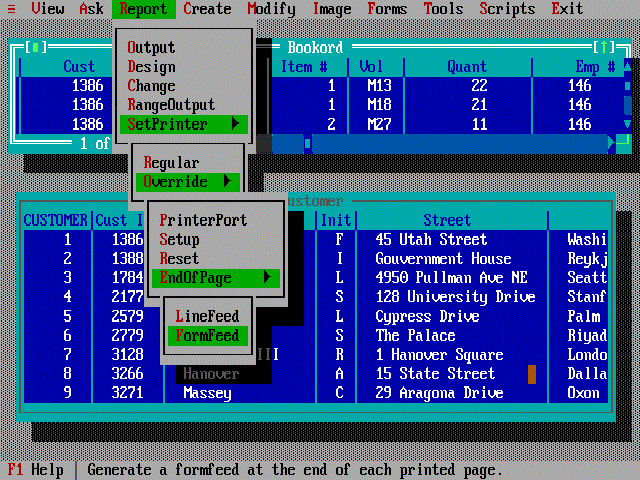
Paradox 4.0 for DOS
One of the features that made Paradox unique and very accessible to non-technical buyers was its "Query By Example", or QBE. This meant rather than having to understand a query language to request data from the database, you were presented with a visual representation of tables where you could enter in commands and give examples and conditions. Microsoft later leveraged this functionality in its own product, Access.
Paradox 2.0 for DOS
Paradox 2.0 was released in 1986 (before Borland's buyout of Ansa Software), but for some version 2.0 boxes that were produced after, the cover read "Ansa - A Borland Company".
Paradox 3.0 for DOS
By the time Paradox 3.0 was launched, the product packaging now mimicked the standard colourful, clean and professional image of the other products in the Borland suite. It sold for a list price of $725 for single user, or $995 for the LAN pack for five additional licences. The Run-time version (which allowed end users to run Paradox databases but without amending the database structure) was just $29.95. Version 3.0 didn't require a heavyweight PC either, being able to run on an IBM PC or XT machine with no hard disk. Of course a hard disk and faster processor were recommended, but not absolutely essential.
It came with nine manuals and two keyboard templates that sat around the function keys.
Paradox 3.0 featured an easy-to-use form designer for data entry purposes, including the ability to have multi-row fields on a form. Putting together queries that joined 3 or 4 multiple tables was extremely easy in Paradox - something that its competitors often had limitations on. It came with Personal Programmer, a means to develop applications using PAL (Paradox Active Language). This also had a built-in debugger. The included Data Entry Toolkit was a library of pre-written routines that could be employed by your application. The number of functions built-in was incredible, and on top of everything else, it was quick.
Compared to rival products at the time, Paradox 3.0 offered the best blend of ease-of-use, speed, and querying power.
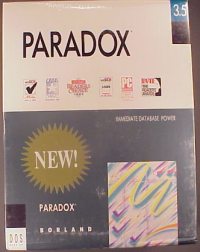
Paradox 3.5 for DOS
Launched in August 1990, Paradox 3.5 was available on both 3.5" or 5.25" floppy disk and often both formats were shipped in the box. It came on nine 360 KB 5.25" floppies or five 720 KB 3.5" floppies. In the box you also got seven manuals and two keyboard templates.
Alongside Paradox 3.5, Borland also released a separate product called Paradox SQL Link, which allowed connectivity to other databases, including those from IBM, Oracle and Microsoft.
Paradox SE for DOS
A "Special Edition" of Paradox arrived in October 1991. Designed to be a database "lite" for non-programmers. In fact Paradox SE was essentially the Paradox 3.0 product with some programming tools removed. It did, however, still include the powerful "Query by Example" (QBE) and full relational database capabilities, along with its report and form capabilities. Of course, lacking from Paradox SE were the enhancements found in Paradox 3.5, including improved memory management and the programmer support features like the Personal Programmer and DataEntry toolkit. Unlike other full-fat Borland products, SE did not ship with a suite of manuals - instead they provided a third-party book entitled The ABCs of Paradox along with an addendum brochure to cover the specifics of the SE version. It sold for just $99.95 retail, or $69.95 direct from Borland during its first month of release.
Paradox 4.0 for DOS
See also my Let's Explore article on this version.
Paradox 4.0 had a list price of $795 at launch in August 1992, but you could upgrade an existing older version to 4.0 for just $199.95. It came on two 1.44 MB floppy disks, having been largely rewritten from scratch in Borland C++. An 'Academic Edition' was also released which was the same as the full version but lacked network support and came with a subset of the manuals - the full release came with a User's Guide, Getting Started, Quick Reference Guide, Network Installation Guide, PAL Programmer's Guide, PAL Reference, and Application Workshop manual, while the Academic Edition lacked the PAL ones and the Network Installation Guide.
A few minor bug fix releases were also pushed out as version 4.01 and 4.02. Paradox 4.02 was the first release to not require the entry of a serial number during installation.
Paradox version 4.0 added these features:-
- Dropdown menus and 'windowing' capability
- Better access to extended (XMS) memory.
- BLOB (Binary Large Object) data type added, with 'Memo' and 'Binary' subtypes.
- Support for secondary indices.
- Use of the Borland Database Engine (BDE) from this version onwards.
The Paradox SQL Link product was also updated to version 4.0, permitting direct connectivity to IBM Extended Edition Database Manager v1.2 or higher, Microsoft SQL Server v1.0 or higher, and Oracle Server v6.0 or higher. You needed Paradox 4.0 to be installed separately.
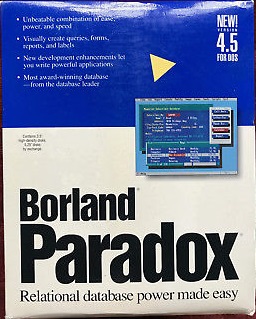
Paradox 4.5 for DOS
Launched in late 1993, Paradox 4.5 was touted as being ten times faster than Paradox 3.5. Like its forebear, it came on two 1.44 MB floppy disks, though like v4.0 you could exchange these for 5.25" disks. Documentation was unchanged from version 4.0, though you did get the '4.5 Upgrade Guide'.
In version 4.5, here's what you got over and above earlier versions:-
- PAL was further updated with a new windowed debugger and 40 new programming commands
- Better mouse support for things like changing column widths, moving and resizing fields on forms and reports, and moving around the database with the scroll bars.
- View your data in a 'full-screen' mode which, depending on your video card, could blow up your data(!) to as much as 132 columns by 43 lines, or 80 columns by 50 lines.
- Import features were enhanced with the ability to import data directly from Quattro/Quattro Pro spreadsheets, Lotus 1-2-3 or Symphony, dBase, PFS:File, Reflex, VisiCalc, or delimited text files.
- Application Workshop allows you to create database applications without writing a single line of code. Create menus, instruct what they should do, such as open a table or run a macro, and the code is written for you.
- Better performance - Borland announced v4.5 was ten times faster than v3.5. Strange that they compare it to a version the pre-dates its immediate predecessor, but perhaps version 4.0 turned out to be somewhat slow. Regardless, we'll take more speed any day!
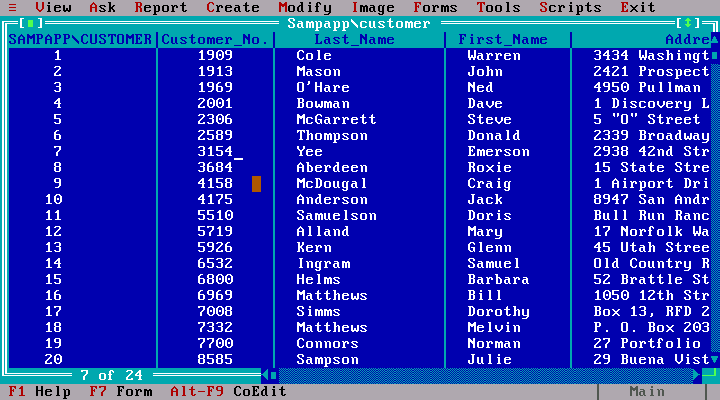
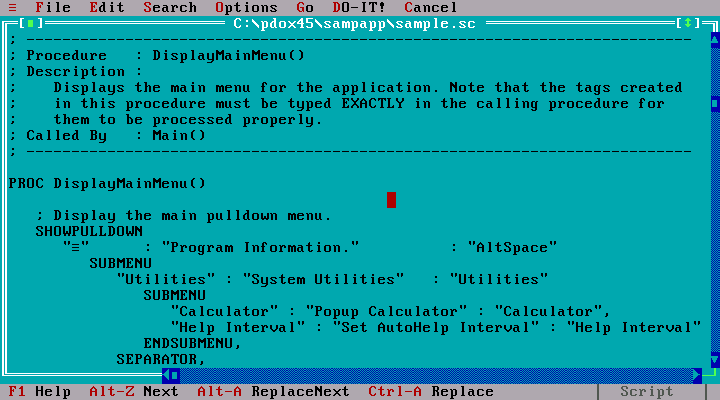
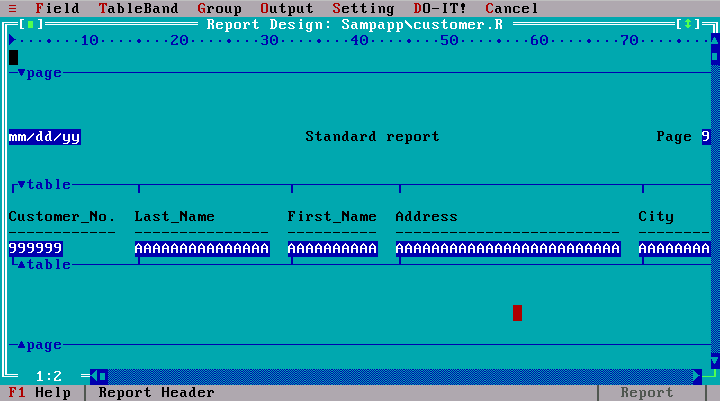
Paradox 4.5 from left: table view, programming in PAL, and the report designer
In late 1992, Borland acquired the ailing Ashton-Tate, authors of the database stalwart, dBase, giving them an 85% share of the commercial database market. Ashton-Tate had been struggling to recode dBase to work on Windows, and had seen their market share fall due to some earlier buggy releases.
Paradox for Windows 1.0
In early 1993, Borland released the first Windows version of Paradox, logically named 'Paradox for Windows 1.0'. This had full compatibility with databases written in Paradox for DOS as well as dBase. At launch it sold for $495, but this was eventually reduced down to just $150.
Microsoft launched Microsoft Access three months after the release of Paradox 4.0, and taking a leaf from Borland's own book with Quattro Pro, they priced it at just $99, severely undercutting the typical price of other database products, including Borland's Paradox. Within a year, the database landscape looked very different. The final death knell for Paradox and other DBMS was when Microsoft bundled Access 2.0 into their Office 4.3 suite in June 1994, offering a word processor, spreadsheet, email, presentation graphics, and database for well below the cost of just a database package alone.
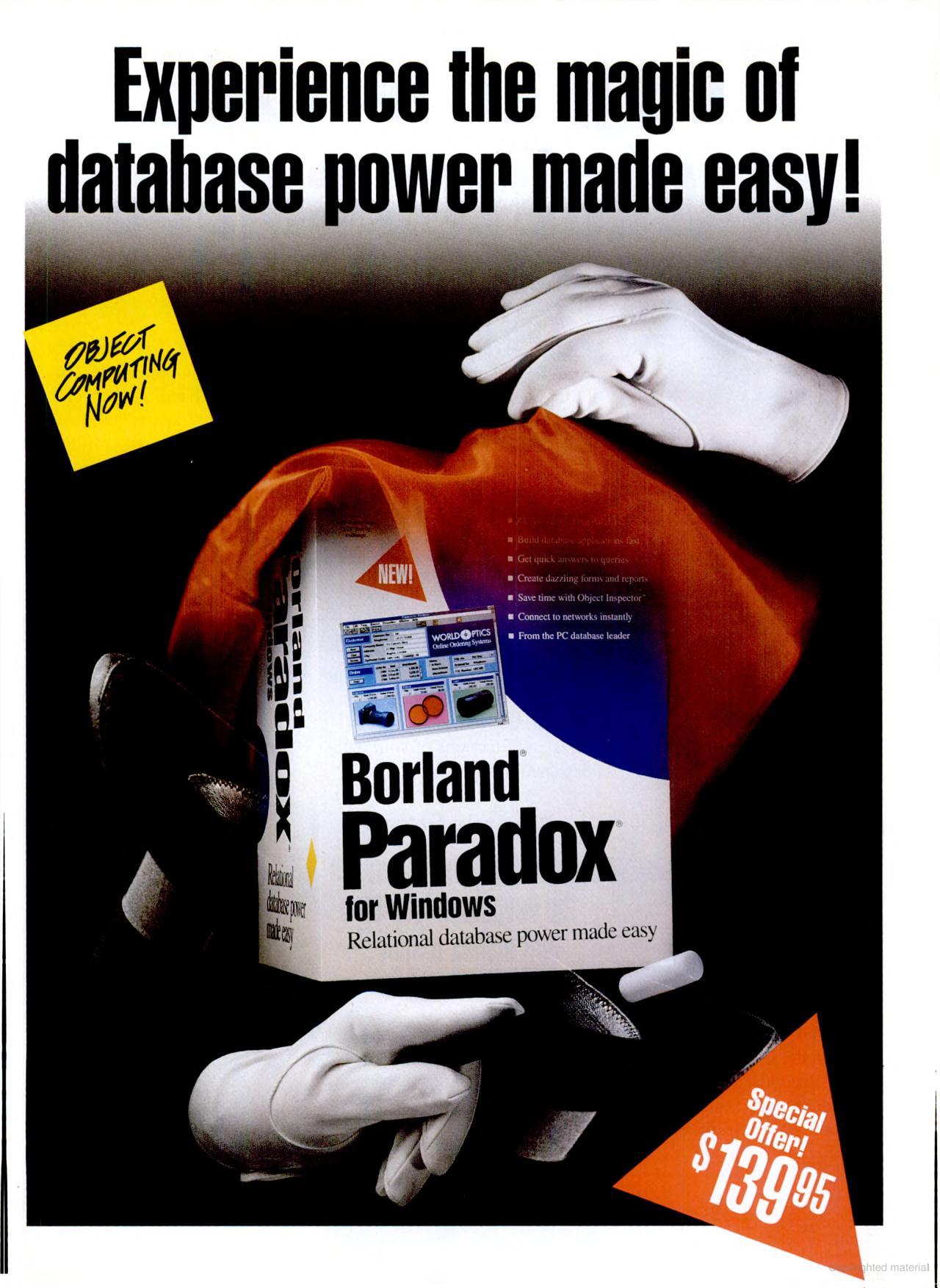
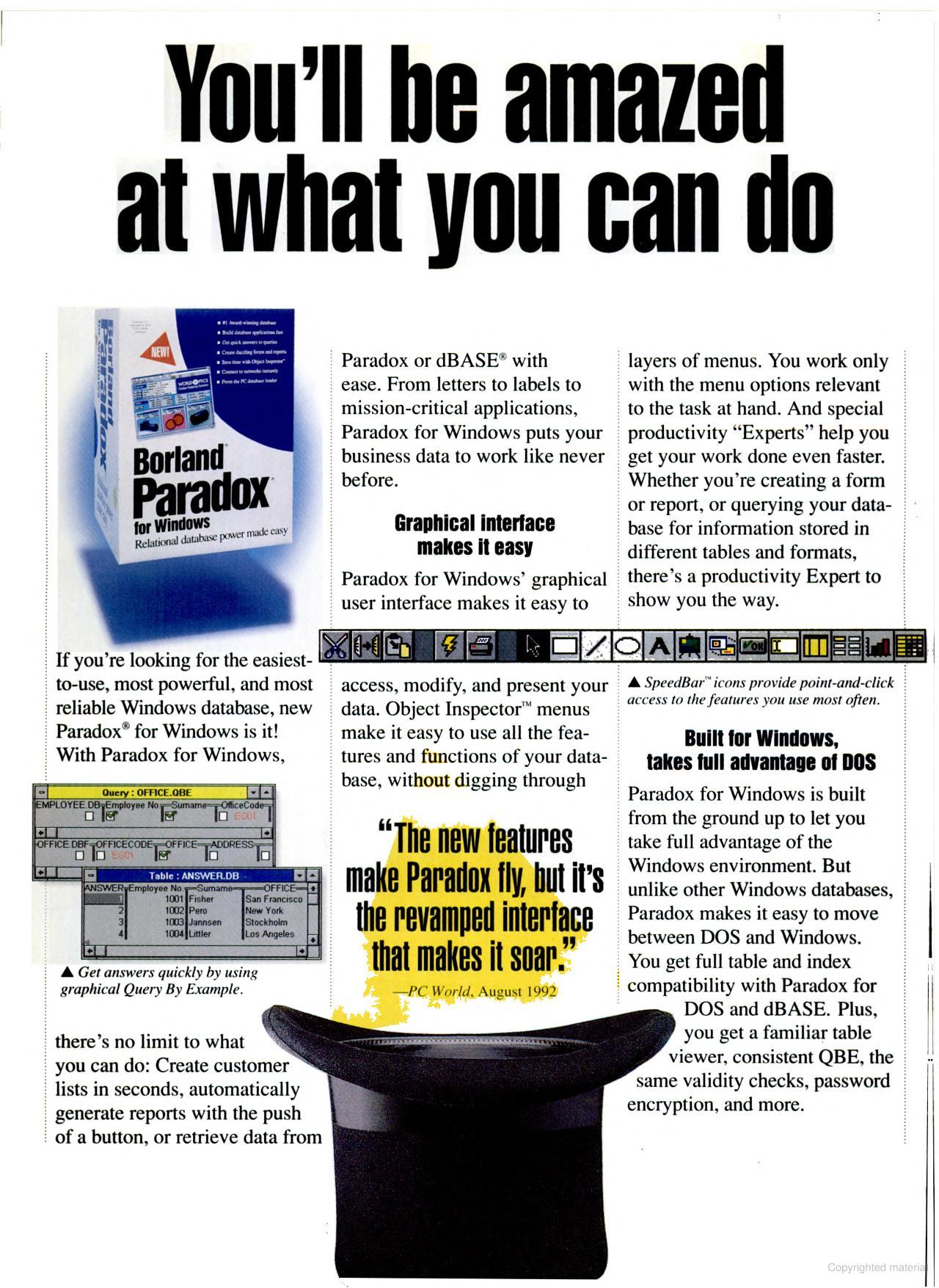
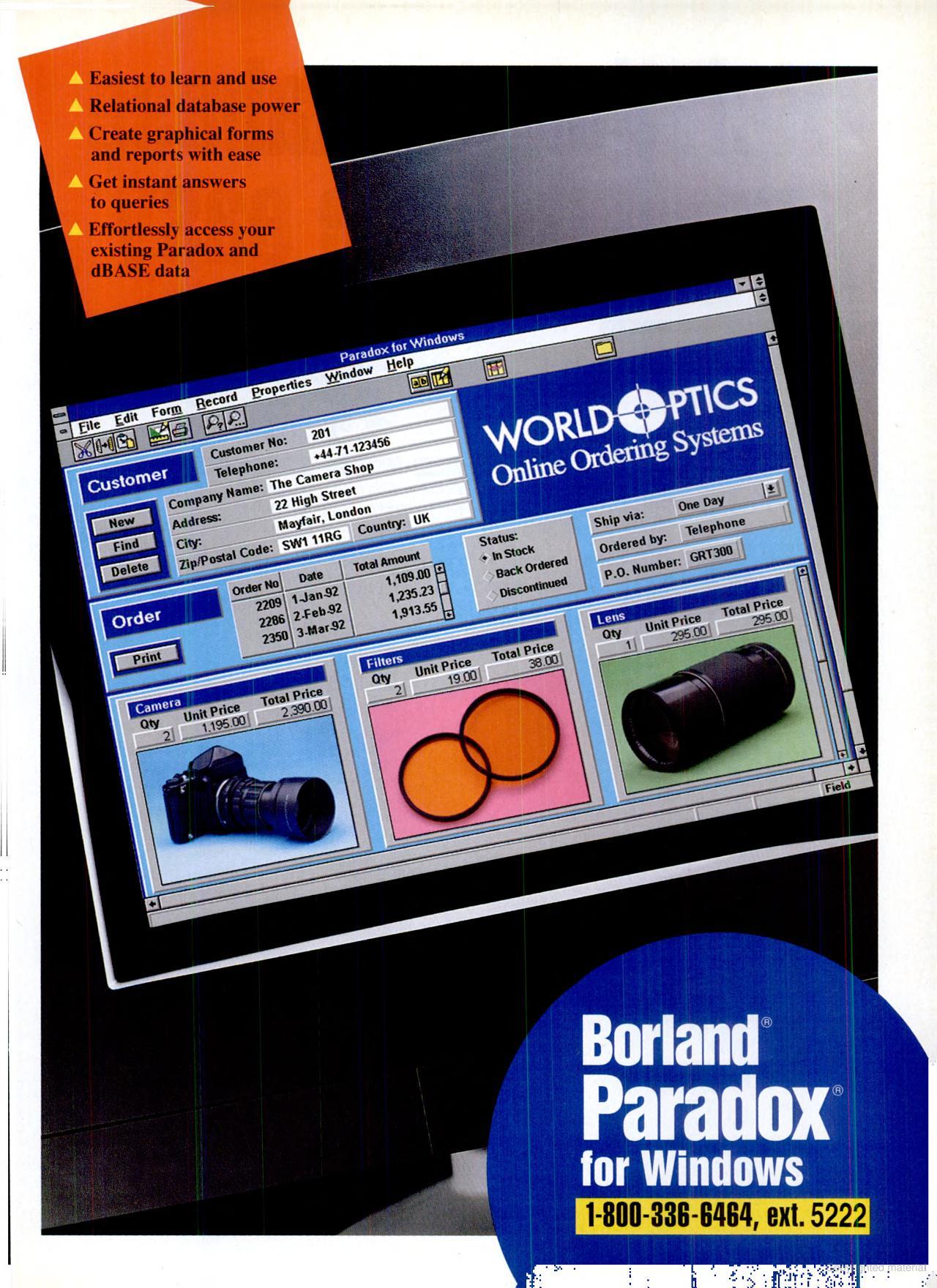
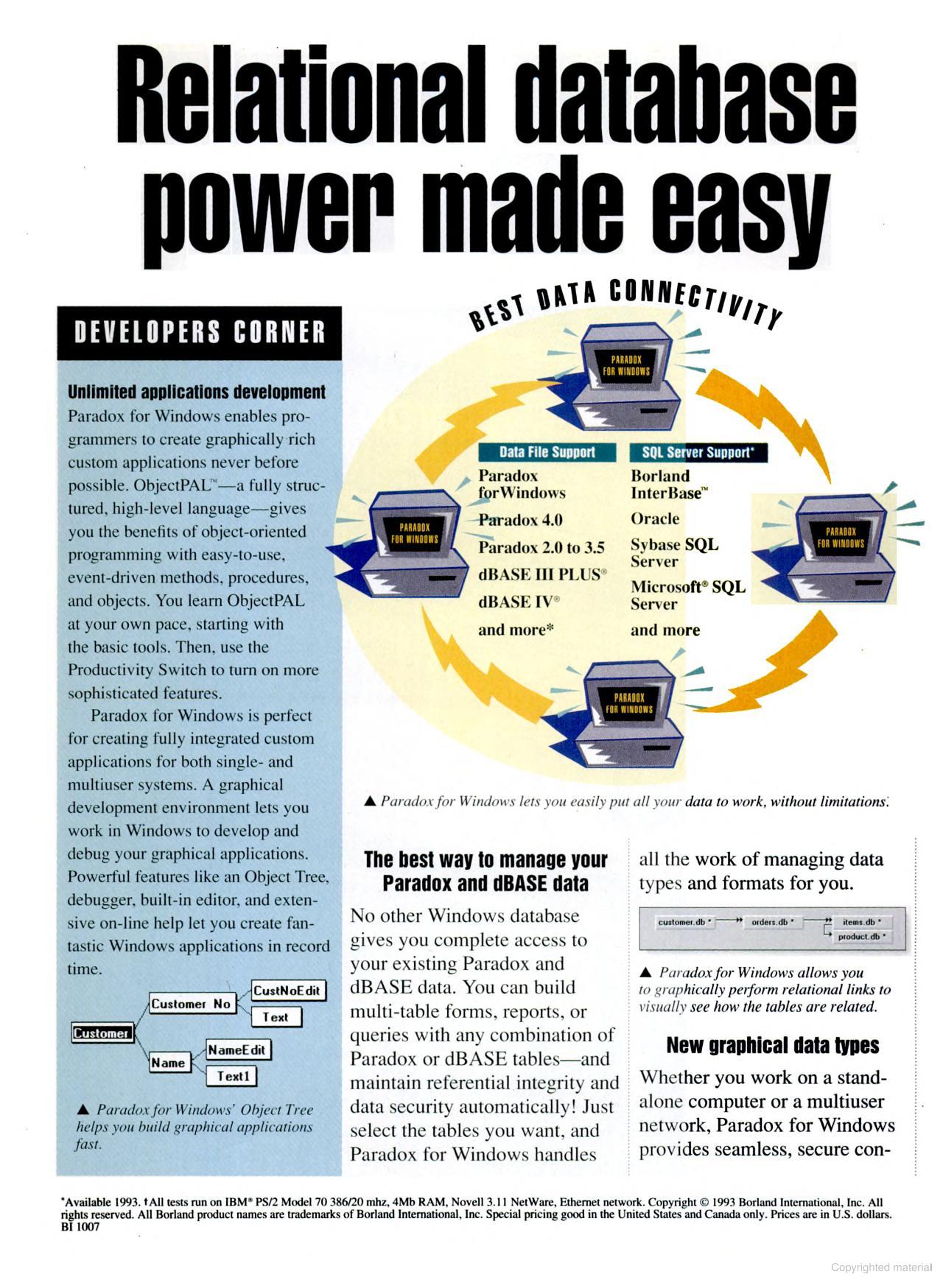
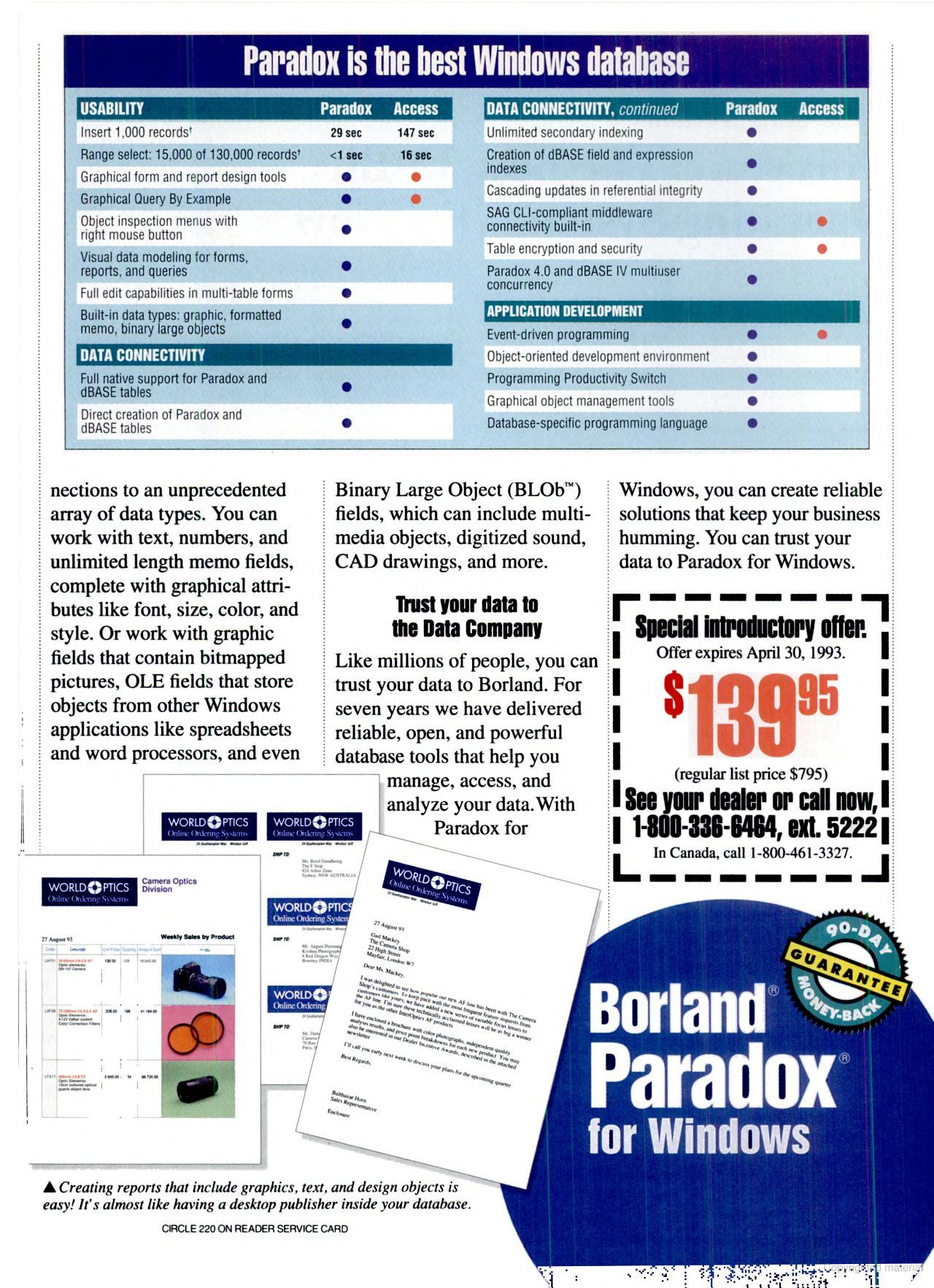
A five-page spread for Borland Paradox for Windows [1.0], in March 1993
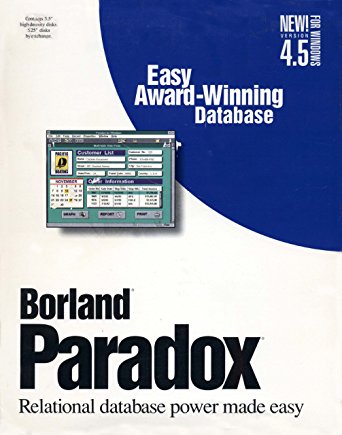
The next version released for Windows (Paradox for Windows 4.5) realigned the version numbering to match the highest version for DOS, 4.5. It retailed for $495 but was later reduced to $150. As they had done previously, if you owned a previous version you could upgrade for a cheaper price. A special 'Workgroup Edition' provided better SQL connectivity, LAN, WAN and email support. You could import data from more sources, including InterBase, Sybase/MS or Oracle. It came on five 1.44 MB floppy disks.
When Corel Corporation bought Borland, they continued the Paradox line of products, and included it in their Corel WordPerfect Office bundle.
Borland also ported Paradox to IBM OS/2, with version 1.0 for OS/2 released in summer 1988. A version 2.0 was also released for OS/2.